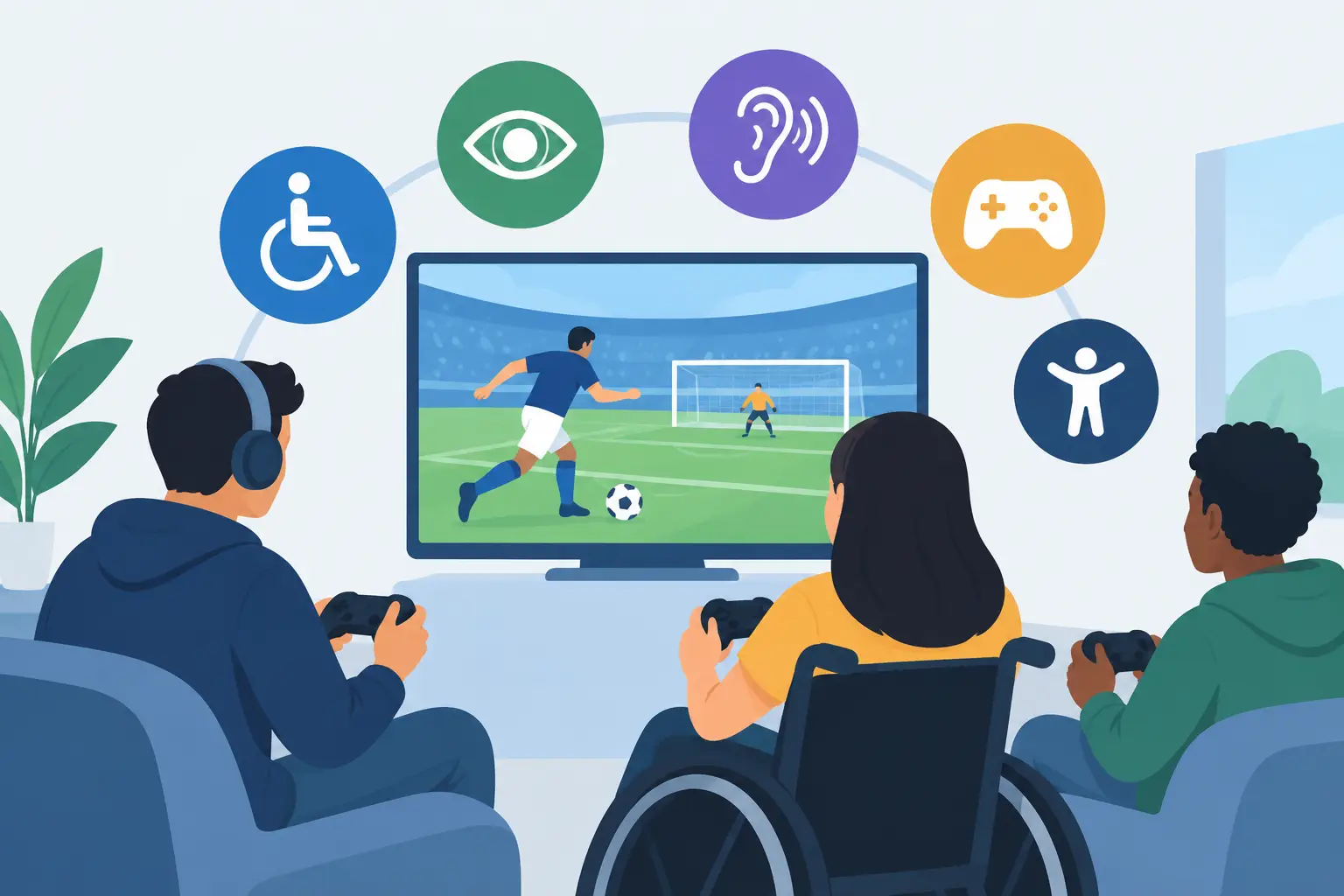
A football game can have brilliant passing, big-match atmosphere, and beautiful stadiums, yet still leave people on the sidelines if it assumes every player sees, hears, reacts, and controls the same way. The best football game accessibility features do more than add settings menus. They give more fans a real chance to read the match, make decisions, compete, and enjoy the pressure of a last-minute winner.
That matters because football belongs to a global community. Players bring different abilities, devices, languages, experience levels, and ways of interacting with games. Accessibility is not a niche extra bolted on after development. It is part of building a football experience that more people can call their own.
What makes a football game truly accessible?
Accessibility starts with a simple goal: reduce unnecessary barriers without removing the excitement of playing well. A player should lose possession because an opponent made a great tackle, not because crucial on-screen information was too small, a button combination was impossible to reach, or commentary was the only way to understand what happened.
The strongest features offer choice. One player may want simplified controls while learning the game. Another may need fully remappable inputs because of limited hand mobility. A deaf or hard-of-hearing player may rely on visual match cues. A blind or low-vision player may need clear audio guidance and strong contrast. None of these needs make someone less of a football fan.
There is also a practical benefit for every player. Clearer menus, adjustable text, flexible difficulty, and less clutter make games easier to pick up after a long day. Accessibility often creates better design, period.
Best football game accessibility features to prioritize
Fully remappable controls
Football games ask players to make fast choices: pass, shoot, switch player, press, tackle, sprint, and use tactics. Default controls work for some hands, but not for all hands. Every important action should be remappable, including menu navigation and advanced commands.
The key is flexibility without confusion. Players should be able to swap individual inputs, choose alternate layouts, save profiles, and avoid forced button holds when a toggle option would work. Support for adaptive controllers matters too. If a player has found a setup that lets them play comfortably, the game should meet them there.
Adjustable game speed and input assistance
A full-speed football match can be thrilling. It can also move too quickly for new players, people with cognitive disabilities, or anyone learning an unfamiliar control scheme. Adjustable match speed creates room to see the field, recognize a run, and make a decision with confidence.
Input assistance needs the same care. Passing support, shooting help, easier skill moves, and optional simplified controls can welcome casual players into the action. The trade-off is competitive fairness. These options are best handled with transparency, especially in ranked online modes, while offline and casual modes should give players the freedom to choose what makes the game fun.
Clear visual information
The pitch is busy by design. Players, kits, shadows, crowds, scoreboards, tactical overlays, and broadcast-style graphics all compete for attention. Strong visual accessibility gives players control over that noise.
Essential options include scalable text, high-contrast menus, colorblind-friendly palettes, and clear player indicators that do not depend on color alone. A player marker can combine color with a shape, icon, or label. Team kits should be checked for contrast before kickoff, not left to chance in a match where quick recognition is everything.
Players should also be able to adjust or remove distracting visual effects such as camera shake, motion blur, flashing lights, and heavy depth-of-field effects. Cinematic presentation has value, but it should never come at the cost of comfort or clarity.
Captions, visual alerts, and meaningful audio choices
Sound carries a lot of football information. Commentary may call a substitution, the referee whistle signals a stop, and crowd noise can build anticipation. But no important gameplay event should exist only in audio.
Captions should identify speakers and significant sound effects, not merely transcribe commentary. Visual indicators can show a whistle, offside call, injury stoppage, or tactical notification. Adjustable subtitle size, background opacity, and text placement help players make captions work for their screen and setup.
At the same time, audio accessibility should go beyond captions. Separate volume controls for commentary, crowd, menu sounds, music, and gameplay effects let players keep the signals they need while lowering the noise they do not. For players with low vision, helpful spatial audio and optional spoken menu feedback can make navigation and play more understandable.
Menus that respect the player
Accessibility often succeeds or fails before the first ball is kicked. If the settings screen is hard to find, labels are vague, or menus time out too quickly, a useful feature becomes inaccessible in practice.
Menus should use plain language, consistent navigation, readable typography, and visible focus indicators. Settings deserve short explanations that tell players what will change. A preview for text size, contrast, camera options, or controller changes saves frustration. It also helps to place accessibility settings near the beginning of the first-time setup, then make them easy to revisit at any moment.
Difficulty that teaches instead of judges
Football gaming should make room for the fan who watches every weekend and the player picking up a controller for the first time. Adjustable difficulty is essential, but a single easy-to-hard slider is rarely enough.
Useful options let players tune elements independently. A player might want smarter opponent positioning but more forgiving shooting, or slower defending while keeping the rest of the game challenging. Training drills, contextual tutorials, replayable tips, and the ability to pause during offline matches can turn a difficult moment into a learning moment.
This is not about making every match easy. It is about letting players find a challenge level that feels exciting rather than excluding.
Communication and online safety options
Online football is at its best when a last-second equalizer leads to celebration, not abuse. Accessible online play includes communication tools that work for different players and strong protections for everyone.
Quick-chat options, text-to-speech and speech-to-text support, and customizable communication settings can make teamwork easier. Players also need simple ways to mute, block, report, or limit unwanted contact. These tools should be easy to reach, clearly explained, and effective. A global football community grows when players can compete without being pushed out by harassment.
Accessibility should be built into the match, not hidden in a menu
The biggest mistake is treating accessibility as a checklist completed at the end of development. A colorblind mode added late may not fix kit clashes. Captions added after audio design may miss key sounds. Remapping introduced after controls are finalized may leave some actions unavailable.
The better approach is to invite disabled players and accessibility specialists into playtesting early and often. Watch where people hesitate. Ask what information is missing. Test on different screens, with different controllers, in noisy rooms, and with assistive technology. Then act on what players say.
Not every feature will be equally valuable to every person. That is exactly why customization matters. A game does not need one definition of the perfect match. It needs enough thoughtful options for more people to create theirs.
A bigger goal for football gaming
The next generation of football entertainment should feel open from the first menu to the final whistle. That means respecting the player who needs larger text, the fan who wants simplified controls, the competitor who communicates differently, and the newcomer who simply needs time to learn.
For a community-powered vision like Infinity Football, accessibility is an exciting part of what it means to build with fans rather than only for them. When more people can take the field, share the moment, and feel the joy of the game, football gaming becomes stronger. The best feature is not one setting. It is the decision to make room for everyone who loves the sport.